

design-research#
The umbrella entry point for the CMU Design Research Collective design-research ecosystem.
design-research supplies one discoverable namespace, exact component
version pins, and compatibility-tested examples for the package family. Its
four wrapper submodules route to public exports owned by the specialized
component packages; the umbrella does not reimplement their research logic.






Get Started#
Python 3.12 or newer is required. A first installed-package session needs only:
python -m venv .venv
source .venv/bin/activate
python -m pip install --upgrade pip
python -m pip install design-research
Then import the package family through the four wrapper submodules:
import design_research as dr

problem_ids = dr.problems.list_problems()
problem = dr.problems.get_problem(problem_ids[0])

print(problem.metadata.title)
print(dr.agents.Workflow)
print(dr.experiments.Study)
print(dr.analysis.validate_unified_table)
Installation explains the base package and component-owned extras.
Quickstart separates installed-package use from repository development.
Learning Path provides the guided path through runnable tutorials.
Study to Evidence to Paper Draft covers the complete retained-evidence and explicit paper-draft handoff.
Compatibility And Package Status records the exact tested versions, package classifiers, and artifact-schema contract.
Important
Joining the IDETC 2026 tutorial on Sunday, August 23? Use the Workshop Setup and Preflight page to download the materials and verify your Python environment before the session.
Architecture: Two Complementary Views#
Control Topology#
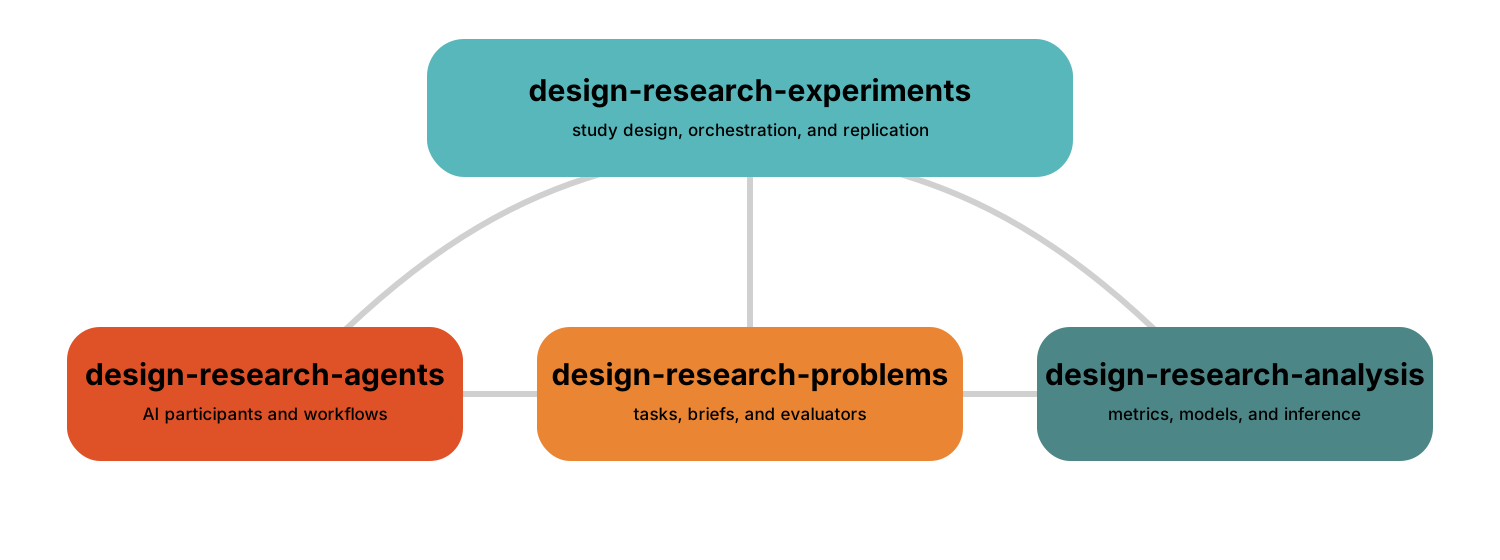
Problems and Agents are peer study inputs. Experiments owns study design and coordinates their execution, then defines the artifact handoff to Analysis.
Runtime And Data Flow#
Problems + Agents → Experiments artifact set → Analysis → evidence that can refine the next study protocol.
These are two views of the same package family, not an installation order. The umbrella routes imports and pins a tested combination; implementation stays with the package that owns each behavior.
Ecosystem Packages#
Problems — tasks, prompts, grammars, benchmarks, and evaluators: documentation · source
Agents — AI participants, workflows, tools, and traceable reasoning: documentation · source
Experiments — hypotheses, factors, conditions, replications, execution, and artifact export: documentation · source
Analysis — validation, transformation, statistics, and visualization: documentation · source
Quality Signals#
Coverage reports the deterministic test suite’s total line coverage;
Examples Passing reports per-file runnable-example results; and
API in Examples reports coverage of curated top-level exports. Use
make coverage, make examples-test, and make examples-coverage to
reproduce them locally.