design-research-agents#
The agent-execution layer for reproducible design research.
What This Library Does#
design-research-agents owns executable AI participants, workflow and tool
runtimes, model-client adapters, and traceable run results. It is built for
research workflows where reproducibility and controlled comparison matter as
much as raw model capability.
Interpretable traces, explicit tool boundaries, and documented workflow contracts are core features. They make agent studies easier to reproduce, compare, and audit across experiments.






Quality Signals#
Coveragereports total line coverage for the default deterministic test suite; CI requires at least 95%.Examples Passingreports checked-in example scripts that execute successfully in the examples workflow.API in Examplesreports curated top-level__all__exports referenced by runnable examples.N/Nmeans every supported top-level export appears in at least one example, and CI requires 100%.
Run make coverage, make examples-test, and make examples-coverage
to reproduce these checks locally.
Highlights#
Two core agent entry points:
DirectLLMCallandMultiStepAgentExplicit multi-step modes for
direct,json, andcodeexecutionA study-facing execution facade in
design_research_agents.studyWorkflow primitives for model, tool, delegate, loop, and memory steps
Model-selection policies with local and remote catalogs
Tool contracts and schemas for safe, structured I/O
Tracing hooks and emitters for debugging, evaluation, and reproducibility
Workflow-native memory and reusable reasoning patterns including tree search, Ralph loops, nominal teams, debate, and RAG
Runnable examples for deterministic validation and experimentation
The public surface is intentionally layered: start with DirectLLMCall for
one-shot execution, move to MultiStepAgent for managed loops, use
Workflow when you need to author reusable graphs, reach for
design_research_agents.patterns when a prebuilt orchestration strategy fits,
and use runnable examples as exemplars rather than as the primary abstraction.
Typical Workflow#
Start from
DirectLLMCallorMultiStepAgentdepending on the level of control you need.Configure runtime mode, tools, models, and any workflow or memory helpers.
Run a deterministic example or local quickstart to validate the environment.
Inspect traces, tool boundaries, and structured outputs for debugging and evaluation.
Reuse the same runtime contracts inside broader experiments through
design_research_agents.study.AgentRunRequest,design_research_agents.study.execute_agent_request(...),design_research_agents.study.normalize_agent_execution(...), and downstream analysis.
Note
New here? Follow Guides for the shared install → quickstart → concepts/workflow → examples → API path. The base quickstart is offline and requires no model service.
Guides#
Learn the base concepts, setup flow, and execution patterns that shape a stable agent-research pipeline.
Examples#
Browse runnable examples and guided landing pages for the major public subsystems.
Reference#
Look up the stable import surface, package extras, and deeper API reference material for the runtime boundaries that matter in CI and downstream studies.
Integration With The Ecosystem#
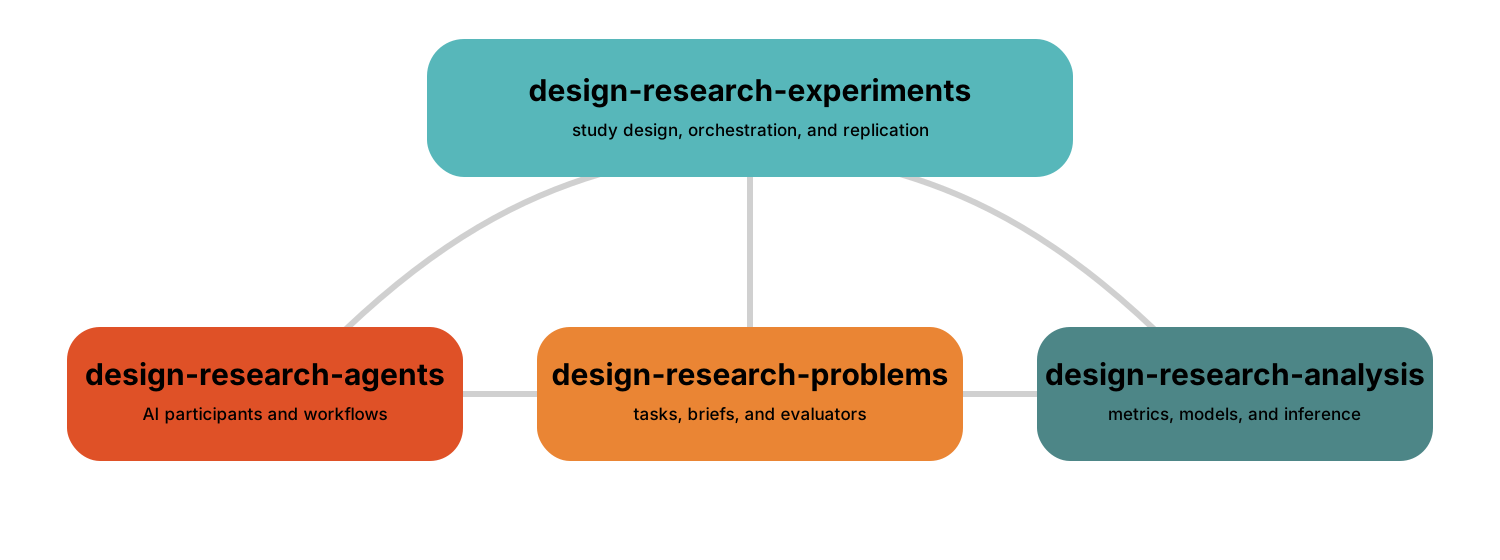
The CMU Design Research Collective design-research ecosystem is a modular set of libraries for studying human and AI design behavior.
design-research-agents (this package) executes AI participants, workflows, and tool-using reasoning patterns.
design-research-problems owns benchmark design tasks, prompts, grammars, and evaluators.
design-research-experiments owns study design and coordinates artifact flows across packages.
design-research-analysis validates and analyzes the resulting traces, event tables, and outcomes.
Together these libraries support end-to-end design research pipelines, from study design through execution and interpretation.
The figure shows two complementary views: control responsibility and runtime artifact flow. Neither view is a package-install order. See the umbrella compatibility matrix for the component versions tested together.